Blurb here introducing the Toolkit.
OVERVIEW
This section includes resources that help explain the Community Health Improvement process.
COMMUNITY HEALTH IMPROVEMENT PROCESS
- What is the Community Health Improvement Process
Frequently asked questions about CHIP, hospital and health department deliverables, and WNC Healthy Impact’s role in the process.
RESULTS-BASED ACCOUNTABILITY (RBA)
- Results-Based Accountability Fact Sheet
A one-page fact sheet that explains RBA, its uses, and how to contact WNC Health Network. -
Results-Based Accountability™ (RBA) Consulting Team—Menu of Services
Comprehensive list of all RBA support services provided by members of WNC Healthy Impact’s RBA Consulting Team -
RBA Basics Video by Erin Braasch & Rebecca Reeve
(Run-time: 20-minutes) video narrated by Erin Braasch and Rebecca Reeve serves as an introduction to Results-Based Accountability. Basics Video is an excerpt from an all-day RBA training, Getting to Results -
RBA 101 Workshop with Mark Freidman (video)
(Run-time: 1 hour) video presentation of the full RBA framework by creator Mark Friedman -
Results-Based Agenda Template with Guidance
An agenda template created to help lead meetings within the framework of RBA. Guidance and prompts are included in purple on this template. -
Results-Based Agenda Template without Guidance
An agenda template created to help lead meetings within the framework of RBA. Guidance and prompts not included on this template.
CLEAR IMPACT SCORECARD
-
Achieving Collective Impact with Results Scorecard – The Collective Impact Toolkit
Slide deck presentation on Achieving Collective Impact with Results Scorecard by Dietre Epps, including additional Collective Impact resources -
Why Results Scorecard™ e-CHIP?
One-pager outlining benefits and purpose behind using Scorecard to develop of electronic CHIPs -
Clear Impact Scorecard™ Terminology
A two-page document outlining and defining helpful Scorecard terminology
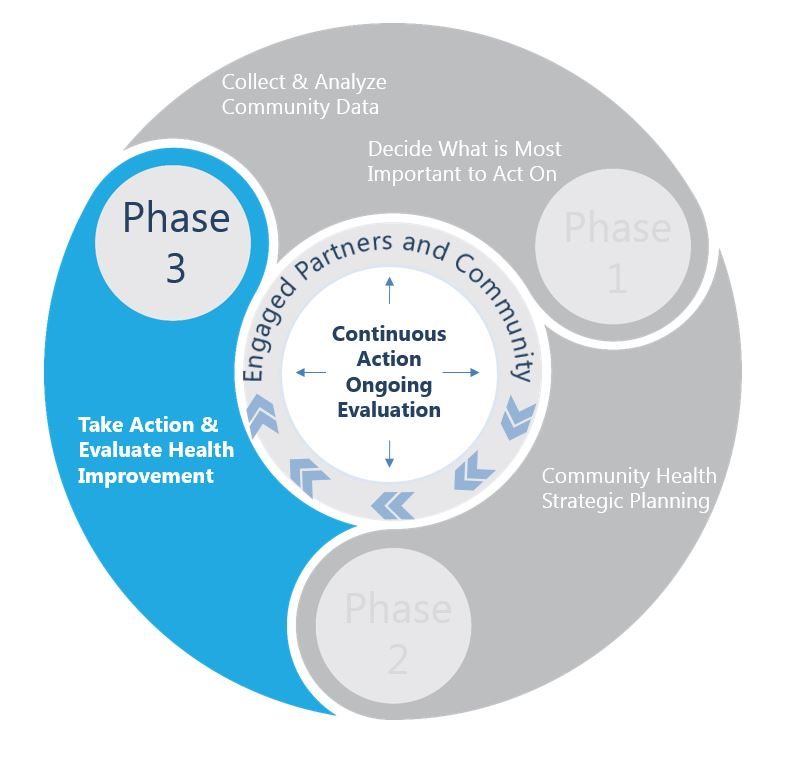
Click on the image below to navigate to resources for each phase of the cycle.

COMMUNITY ENGAGEMENT & COMMUNICATION (ONGOING)
ENGAGEMENT TOOLS
Engagement Tools – To come
COMMUNICATION TOOLS: CHA
- Distribution Plan Worksheet
Use this worksheet to help you plan and track how you will share the CHA Report with your community. - Prioritization Process Press Release Template
A template to help you craft a press release for the media about your county’s prioritization process. - CHA Report Release Press Release Template
A template to help you craft a press release for the media about your county’s prioritization process. - Local CHA Priority Video Script Template
A template script for you to complete in order to create a personalized video to publicize your CHA priorities.
COMMUNICATION TOOLS: CHIP
- Handout: About the Community Health Improvement Plan
A brief hand-out PDF that outlines: why CHIP, why Scorecard, how to navigate Scorecard. Can be linked to and/or embedded in the Scorecard and/or websites and other public-facing presentations and platforms. - Presentation slides
Template slides that help you walk through your CHIP with local stakeholders. You may tailor these as needed given your audience and the amount of time that you have.
- Infographic template
Infographic to help illustrate a high level view of the result, indicators, strategies, and performance measures for each of your health priorities. You may hyperlink to different sections of your CHIP scorecard. Can be used in many different formats.
COLLECT & ANALYZE COMMUNITY DATA (PHASE 1)
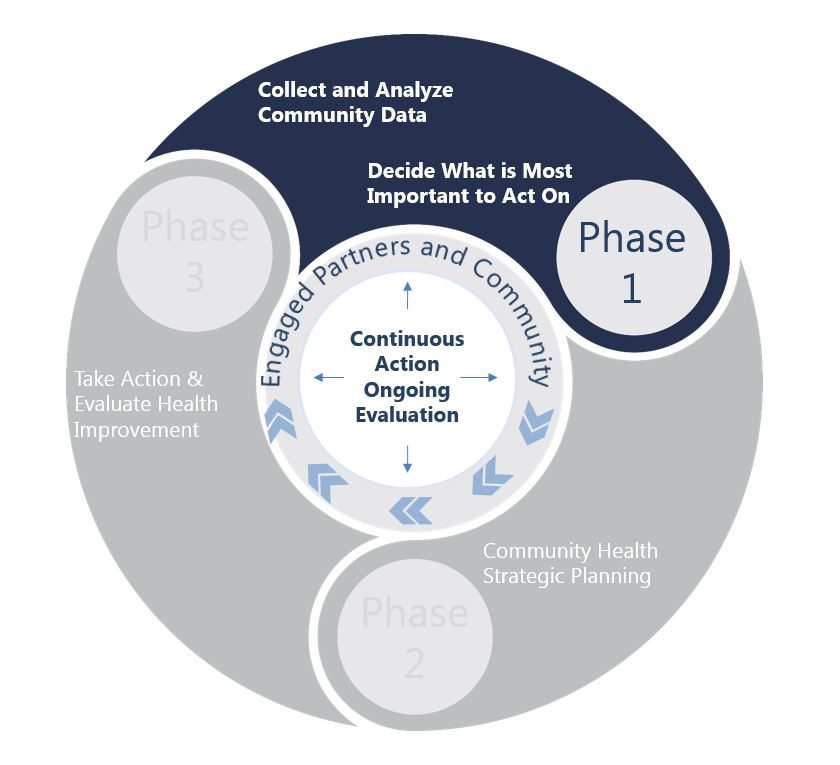
In the first phase of the cycle, CH(N)A leads collect and analyze community data – deciding what data they need and making sense of it.
DATA COLLECTION
Local Data Collection
- Primary Data Collection Methods
Table demonstrating purpose, strengths and challenges of 4 primary data collection method - “Listening to Community” (Primary/ Qualitative Data Collection)
- Listening to Community Training Slides
- WNC Healthy Impact Listening Session Action Plan
- Methods for Listening to Community Worksheet
- Participant Types
- Listening Session Checklists
- Question Guide and Script
- Listening Session Description
- Listening Session Consent Form
- Phone Script
- Participant Sign-in Sheet
- Listening Session Note-Taking Form
- Situation, Behavior, Impact (SBI) Feedback Form
- Selecting Audience
- Question Bank
- Secondary Data Collection
- Additional Local Secondary Data Collection
3-page document listing resources for collecting local secondary data - Local Data Request Email Template
Email template outlines useful information to include when requesting local data. Also includes a sample email.
- Additional Local Secondary Data Collection
Regional Data Collection
- Regional Primary Data Collection
-
PRC Community Survey FAQ (Oct 2018)
Common questions regarding phone surveying and responses from WNC Healthy Impact Data Consulting Team, PRC (research firm conducting surveys) and Sparrow Research (firm that analyzes phone survey for our region) -
2018 WNC Healthy Impact Proposed Core Dataset
Summary of current proposed dataset, including primary and secondary indicators -
2018 Community Health Survey Core Questions
Summary of 75 core questions and wording included in phone survey, as well as years included in the survey -
2018 Community Health Survey County Questions
List of 3 questions asked specifically to each of the 16 counties in western North Carolina -
2018 PRC Phone Survey Script
The telephone survey script used by PRC to administer the 2018 Community Health Survey -
2018 Online Key Informant Survey
The instructions and questions included in the 2018 Key Informant Survey (electronic survey) -
PRC Methodology Approach
3-page document explaining Professional Research Consultants’ role in CHA data collection, as well as approach and methods used
-
DATA PRODUCTS
- 2018 CHA Data Workbook (1o.3.19)
Most recent version of the CHA Data Workbook. - 2018 CHA Data Presentation Slide Template
PowerPoint slide template for data presentations (includes process slides, section dividers with images, and sample table/chart formats) - 2018 CHA Data Presentation Guidance
Guidance, methods, and sample presentation outlines (designed to be used as standalone guidance or with the CHA Data Presentation Slide Template)
DATA ANALYSIS
- Making Sense of Story (Qualitative) Data
- Slides for the October, 2018 Making Sense of Story Data Training
- Discovering Clusters & Themes Activity Instructions
Instructions to guide you to discover themes in your story data. - Data Reporting Form Template
Template to capture and report your story data themes.
- County 2-1-1 Resource List Instructions & Gap Analysis Project
Public health departments in western North Carolina submit Community Health Assessments (CHAs) every 3 years as part of their state public health accreditation requirements. Each county CHA is required to include a county resource list. Updating the 2-1-1 resource list also helps ensure that county residents get connected to the local resources that they need. - Health Data Definitions and Resources (Oct 2018)
- Free Word Cloud Software
TEAMS/PROCESS
- Data Best Practices Webinar
(Run time: 1 hour) video presentation narrated by Jo Bradley and Emily Kujawa on data best practices, including data collection, security and storage, and reporting
DECIDE WHAT IS MOST IMPORTANT TO ACT ON (PHASE 1)
In the first phase of the cycle, CH(N)A leads then decide what is most important to act on by clarifying the desired conditions of wellbeing for their population and by then determining local health priorities. The first phase results in the Community Health Assessment Report from public health, and the Community Health Needs Assessment Summary from hospitals.
PRIORITIZATION TOOLS
-
Data Analysis – Size and Severity (Worksheet)
This worksheet is designed to help you analyze your Community Health Assessment (CHA) morbidity and mortality data. This tool may be used by an individual or a group to prioritize which indicators should be considered as a part of community prioritization. - Concern and Resources Grid (Worksheet)
This worksheet is designed to help you organize key informant data by level of concern and availability of resources. Listening session data may also be included in this part of the analysis. - Other Data Stand Outs (Worksheet)
This table can be used to hold the modifiable and non-modifiable risk factor data that you determine stand out. These data will include social determinants of health, physical environment, health care access, demographics, and health behavior. - Key Issue Template
This tool is adapted from the original that was developed by Buncombe County’s CHA/CHIP leaders, along with their Mission Hospital partners. They (and now others) have used this template to create a single, 2-sided handout for each of the 10 or so key health issues they presented to the people/group deciding on priorities. Pair this packet of rich information with corresponding slides in a presentation to prepare people to score and select priorities. You may then use this content in your CHA Report and other handouts. - Local Rating and Prioritization (Worksheet)
This worksheet helps to list key health issues, and rate and score each by priority level.
CHA & CHNA REPORTS
A template to help health departments draft their 2018 Community Health Assessment Report.
2018 CHA Distribution Plan Worksheet
Use this worksheet to help you plan and track how you will share the CHA Report with your community.
2019 Hospital CHNA Summary Template
A template to help hospitals draft their 2019 Community Health Needs Assessment Report.
COMMUNITY HEALTH STRATEGIC PLANNING (PHASE 2)
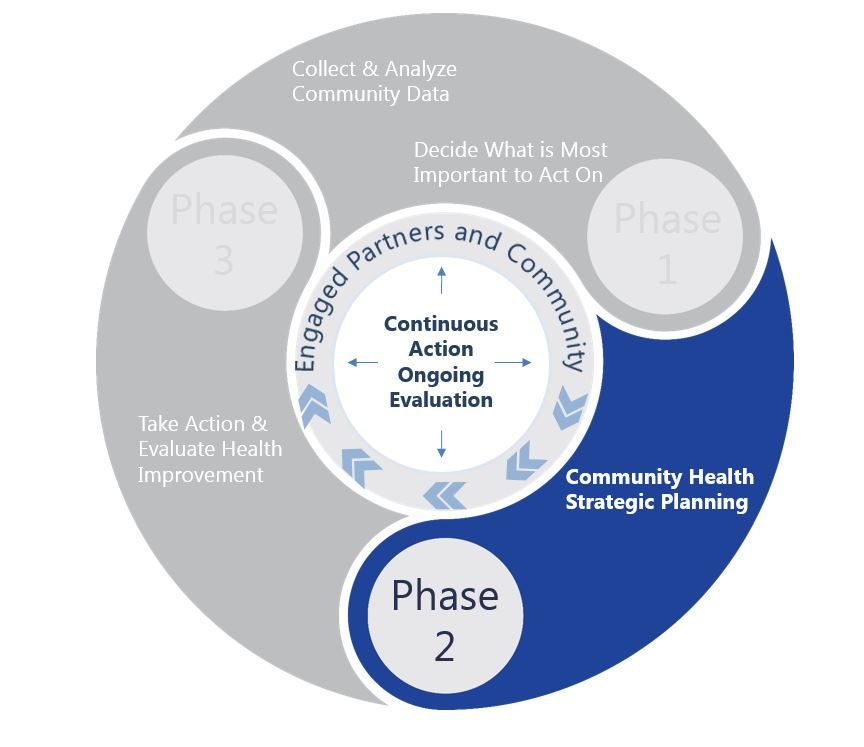
The second phase of the cycle is community health strategic planning. In this phase, leads make a plan with partners about what works to do better, form workgroups around each strategic area, clarify customers, and determine customer results and measures. The second phase results in a Community Health Improvement Plan (CHIP) and Action Plan forms from public health, and in a Hospital Implementation Strategy from hospital
COMMUNITY HEALTH STRATEGIC PLANNING TOOLS
Getting Organized Checklist
This document is intended to help you think through how you will work/who you will work with to develop your CHIP
CHIP Worksheet – UPDATED
This worksheet is designed as a “road map” to guide you in gathering the information needed to complete you electronic CHIP (e-CHIP). Working through this can reveal what information you already have and what work you may want to do with your work groups/coalitions to get to meaningful strategies for your community.
Whole Distance Exercise Instructions
The purpose of this document is to guide you in facilitating the RBA Whole Distance Exercise (WDE) at either the population or the performance level. The WDE takes you through the whole 7 step Results-Based AccountabilityTM thinking process for either Population or Performance levels. This process supports transparency by outlining how you got to your decisions on strategies or actions and is a tool that can be used effectively with a wide range of participants, regardless of education level or background, bringing more equity and inclusion to your planning processes.
Instructions_Clarifying Results
Guide to facilitating a conversation about community-level results for your priority health issues.
Instructions_Prioritizing Indicators
Instructions on narrowing your CHIP focus, i.e. “Which curve will be focus on turning.” Includes criteria and dot-voting instructions.
Worksheet for selecting strategies (8.5×11)
Tool to help a group select specific elements of the “Story Behind the Data”
Worksheet for selecting strategies (11×17)
Same tool as above, just a larger size
Labels (lead.collaborate.support)
Labels for strategy selection sticky notes for Worksheet for Selecting Strategies
Picture of the tool, prepared with sticky notes with labels
CHIP TOOLS & REPORTS
- 2019 Community Health Improvement Plan (e-CHIP) Template
- PDF version of the 2019 Scorecard e-CHIP structure with guidance.
- e-CHIP Exploration Worksheet and Checklist
- The Exploration Worksheet guides you through the new e-CHIP scorecard and prompts you to make notes or ask questions so that you know how to use the software and guidance to complete your 2019 CHIP.
- Accreditation Checklist and Scorecard Crosswalk
- This document crosswalks accreditation/ consolidates agreement checklists with the 2019 e-CHIP guidance.
- CHIP Worksheet
- This document aligns with the e-CHIP guidance. You can use this document to help organize the information for your e-CHIP.
- Variance Email
- This document includes language you can use to remind your NC DPH CHIP reviewer that you will be submitting your 2019 CHIPs in Scorecard.
Hospital Tools - HIS
Hospital Implementation Strategy (HIS) Template
This is the facility-specific implementation strategy template for hospitals to address the community health needs identified through a collaborative community health needs assessment (CHNA) process conducted with local and regional partners in western North Carolina.
TAKE ACTION & EVALUATE HEALTH PERFORMANCE (PHASE 3)
In the third phase of the cycle, CH(N)A leads take action and evaluate health improvement. They do this by planning how to achieve customer results and putting the plan into action. Workgroups continue to meet, and monitor customer results and make changes to the plan as needed. The third phase results in a State of the County Health (SOTCH) Report from public health, and in an IRS Form 990 – Schedule H from hospitals.
ACTION TOOLS
-
2016-2019 Regional Health Priority Scorecards and Tool Kits
One-pager describing how Scorecards can be used in regards to local and regional data, as well as links to three regional health priority Scorecards (Chronic disease, substance use, social determinants of health)
-Chronic Disease Scorecard & Toolkit
-Substance Use Scorecard & Toolkit
-Social Determinants of Health Scorecard & Toolkit -
Work Plan Template
Table template to help in the organization and implementation for a specific program/intervention/strategy -
Action Mapping Tool
Example of what action mapping looks like -
Worksheet designed to help guide performance monitoring and improvement efforts within the RBA framework
-
Worksheet—Performance Measure Grid
Blank template designed in RBA format that helps to develop performance measures for a certain program/intervention/strategy -
Performance Turn the Curve Report Template
Blank template designed in RBA format to help develop a Performance Turn the Curve Report -
Population Turn the Curve Report Template
Blank template designed in RBA format to help develop a Population Turn the Curve Report -
Worksheet—My RBA Elevator Speech
Blank template designed in RBA format to help develop an “elevator speech;” a simple, clear, concise way to describe a program/intervention/strategy