
The content of this page is intended to serve as a resource for hospitals, public health agencies, and key regional partners of WNC Healthy Impact. If you have any questions or need additional support, please contact us. Thanks for all that you do!
OVERVIEW
This section includes resources that help explain WNC Healthy Impact and the Community Health Improvement process.
WNC HEALTHY IMPACT
-
WNC Healthy Impact Fact Sheet
More information about WNC Health Network’s Healthy Impact program goals, partners, efforts, and timeline -
Details & Deliverables
Check out this schedule to see events, projects, and priorities on a local and regional level. Dates from January 2018 to September 2019 -
Infographics
COMMUNITY HEALTH IMPROVEMENT PROCESS
- What is the Community Health Improvement Process
Frequently asked questions about CHIP, hospital and health department deliverables, and WNC Healthy Impact’s role in the process.
REGIONAL PRIORITY SCORECARDS
- Regional Priority Scorecard & Tool Kits Fact Sheet
This one-pager outlines how Online Scorecards may be used, as well as what is included in the different sections (Results, Indicators, and Strategies/Programs). - Chronic Disease Scorecard and Tool Kit
- Substance Use Scorecard and Tool Kit
- Social Determinants of Health Scorecard and Tool Kit
RESULTS-BASED ACCOUNTABILITY (RBA)
-
Results-Based Accountability™ (RBA) Consulting Team—Menu of Services
Comprehensive list of all RBA support services provided by members of WNC Healthy Impact’s RBA Consulting Team -
RBA Basics Video by Erin Braasch & Rebecca Reeve
(Run-time: 20-minutes) video narrated by Erin Braasch and Rebecca Reeve serves as an introduction to Results-Based Accountability. Basics Video is an excerpt from an all-day RBA training, Getting to Results -
RBA 101 Workshop with Mark Freidman (video)
(Run-time: 1 hour) video presentation of the full RBA framework by creator Mark Friedman -
Results-Based Agenda Template with Guidance
An agenda template created to help lead meetings within the framework of RBA. Guidance and prompts are included in purple on this template. -
Results-Based Agenda Template without Guidance
An agenda template created to help lead meetings within the framework of RBA. Guidance and prompts not included on this template.
CLEAR IMPACT SCORECARD
-
Achieving Collective Impact with Results Scorecard – The Collective Impact Toolkit
Slide deck presentation on Achieving Collective Impact with Results Scorecard by Dietre Epps, including additional Collective Impact resources -
Why Results Scorecard™ e-CHIP?
One-pager outlining benefits and purpose behind using Scorecard to develop of electronic CHIPs -
Clear Impact Scorecard™ Terminology
A two-page document outlining and defining helpful Scorecard terminology

COMMUNITY ENGAGEMENT & COMMUNICATION (ONGOING)
ENGAGEMENT TOOLS
-
iap2 Public Participation Spectrum
Table listing data collection methods and strategies that involve public participation and respective impacts
COMMUNICATION TOOLS: WNC HEALTHY IMPACT
About WNC Healthy Impact
-
WNC Healthy Impact Presentation Template Slides
Use this accordion slide deck to put together presentations about WNC Healthy Impact, CHA, CHIP, RBA, and related trainings - WNC Healthy Impact Infographics
-
Frequently Asked Questions for Hospital Stakeholders
4-page document answering questions and providing useful information for hospital stakeholders - WNC Healthy Impact – FAQ for Public Health Agencies
3-page document answering questions and providing useful information for public health agencies -
WNC Healthy Impact Fact Sheet
More information about WNC Health Network’s Healthy Impact program goals, partners, efforts, and timeline
- Summary of Stakeholder Roles
2-page document describing roles and responsibilities of hospital stakeholders for partner hospitalsWNC Healthy Impact Map
-
WNC Healthy Impact Map
Map of Western North Carolina depicting 33 hospital and public health agencies in partnership with WNC Healthy Impact - Templates
-
Worksheet—My RBA Elevator Speech
Blank template designed in RBA format to help develop an “elevator speech;” a simple, clear, concise way to describe a program/intervention/strategy
COMMUNICATION TOOLS: CHA
- 2018 CHA Distribution Plan Worksheet
Use this worksheet to help you plan and track how you will share the CHA Report with your community. - Prioritization Process Press Release Template
A template to help you craft a press release for the media about your county’s prioritization process.
COLLECT & ANALYZE COMMUNITY DATA (PHASE 1)
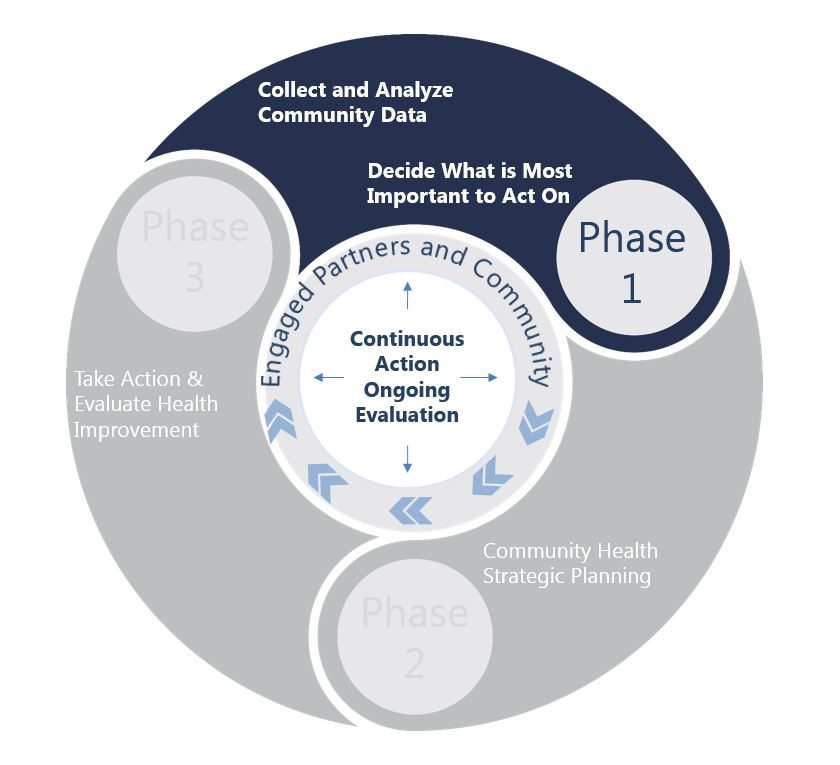
In the first phase of the cycle, CH(N)A leads collect and analyze community data – deciding what data they need and making sense of it.
DATA COLLECTION
Local Data Collection
- Primary Data Collection Methods
Table demonstrating purpose, strengths and challenges of 4 primary data collection method - “Listening to Community” (Primary/ Qualitative Data Collection)
- Listening to Community Training Slides
- WNC Healthy Impact Listening Session Action Plan
- Methods for Listening to Community Worksheet
- Participant Types
- Listening Session Checklists
- Question Guide and Script
- Listening Session Description
- Listening Session Consent Form
- Phone Script
- Participant Sign-in Sheet
- Listening Session Note-Taking Form
- Situation, Behavior, Impact (SBI) Feedback Form
- Selecting Audience
- Question Bank
- Photovoice
- Photovoice for CHA, Deanna LaMotte
Slide deck introducing Photovoice and its role in CHA data collection and analysis - Photovoice Handout, Deanna LaMotte
1-pager introduction and instruction to getting started with Photovoice data collection, as well as additional resources for Photovoice - Photovoice Kit
Link to Photovoice website to learn more about the toolkit, including pricing
- Photovoice for CHA, Deanna LaMotte
- Secondary Data Collection
- Additional Local Secondary Data Collection
3-page document listing resources for collecting local secondary data - Local Data Request Email Template
Email template outlines useful information to include when requesting local data. Also includes a sample email.
- Additional Local Secondary Data Collection
Regional Data Collection
- Regional Primary Data Collection
-
PRC Community Survey FAQ (Oct 2018)
Common questions regarding phone surveying and responses from WNC Healthy Impact Data Consulting Team, PRC (research firm conducting surveys) and Sparrow Research (firm that analyzes phone survey for our region) -
2018 WNC Healthy Impact Proposed Core Dataset
Summary of current proposed dataset, including primary and secondary indicators -
2018 Community Health Survey Core Questions
Summary of 75 core questions and wording included in phone survey, as well as years included in the survey -
2018 Community Health Survey County Questions
List of 3 questions asked specifically to each of the 16 counties in western North Carolina -
2018 PRC Phone Survey Script
The telephone survey script used by PRC to administer the 2018 Community Health Survey -
2018 Online Key Informant Survey
The instructions and questions included in the 2018 Key Informant Survey (electronic survey) -
PRC Methodology Approach
3-page document explaining Professional Research Consultants’ role in CHA data collection, as well as approach and methods used
-
DATA PRODUCTS
- 2018 CHA Data Workbook (11.12.18)
Most recent version of the CHA Data Workbook (includes primary-CHA Survey and secondary data) - 2018 CHA Data Presentation Slide Template
PowerPoint slide template for data presentations (includes process slides, section dividers with images, and sample table/chart formats) - 2018 CHA Data Presentation Guidance
Guidance, methods, and sample presentation outlines (designed to be used as standalone guidance or with the CHA Data Presentation Slide Template)
DATA ANALYSIS
- Making Sense of Story (Qualitative) Data
- Slides for the October, 2018 Making Sense of Story Data Training
- Discovering Clusters & Themes Activity Instructions
Instructions to guide you to discover themes in your story data. - Data Reporting Form Template
Template to capture and report your story data themes.
- County 2-1-1 Resource List Instructions & Gap Analysis Project
Public health departments in western North Carolina submit Community Health Assessments (CHAs) every 3 years as part of their state public health accreditation requirements. Each county CHA is required to include a county resource list. Updating the 2-1-1 resource list also helps ensure that county residents get connected to the local resources that they need. - Health Data Definitions and Resources (Oct 2018)
- Free Word Cloud Software
TEAMS/PROCESS
- Data Best Practices Webinar
(Run time: 1 hour) video presentation narrated by Jo Bradley and Emily Kujawa on data best practices, including data collection, security and storage, and reporting
DECIDE WHAT IS MOST IMPORTANT TO ACT ON (PHASE 1)
In the first phase of the cycle, CH(N)A leads then decide what is most important to act on by clarifying the desired conditions of wellbeing for their population and by then determining local health priorities. The first phase results in the Community Health Assessment Report from public health, and the Community Health Needs Assessment Summary from hospitals.
PRIORITIZATION TOOLS
-
Data Analysis – Size and Severity (Worksheet)
This worksheet is designed to help you analyze your Community Health Assessment (CHA) morbidity and mortality data. This tool may be used by an individual or a group to prioritize which indicators should be considered as a part of community prioritization. - Concern and Resources Grid (Worksheet)
This worksheet is designed to help you organize key informant data by level of concern and availability of resources. Listening session data may also be included in this part of the analysis. - Other Data Stand Outs (Worksheet)
This table can be used to hold the modifiable and non-modifiable risk factor data that you determine stand out. These data will include social determinants of health, physical environment, health care access, demographics, and health behavior. - Key Issue Template
This tool is adapted from the original that was developed by Buncombe County’s CHA/CHIP leaders, along with their Mission Hospital partners. They (and now others) have used this template to create a single, 2-sided handout for each of the 10 or so key health issues they presented to the people/group deciding on priorities. Pair this packet of rich information with corresponding slides in a presentation to prepare people to score and select priorities. You may then use this content in your CHA Report and other handouts. - Local Rating and Prioritization (Worksheet)
This worksheet helps to list key health issues, and rate and score each by priority level.
CHA & CHNA REPORTS
A template to help health departments draft their 2018 Community Health Assessment Report.
2018 CHA Distribution Plan Worksheet
Use this worksheet to help you plan and track how you will share the CHA Report with your community.
COMMUNITY HEALTH STRATEGIC PLANNING (PHASE 2)
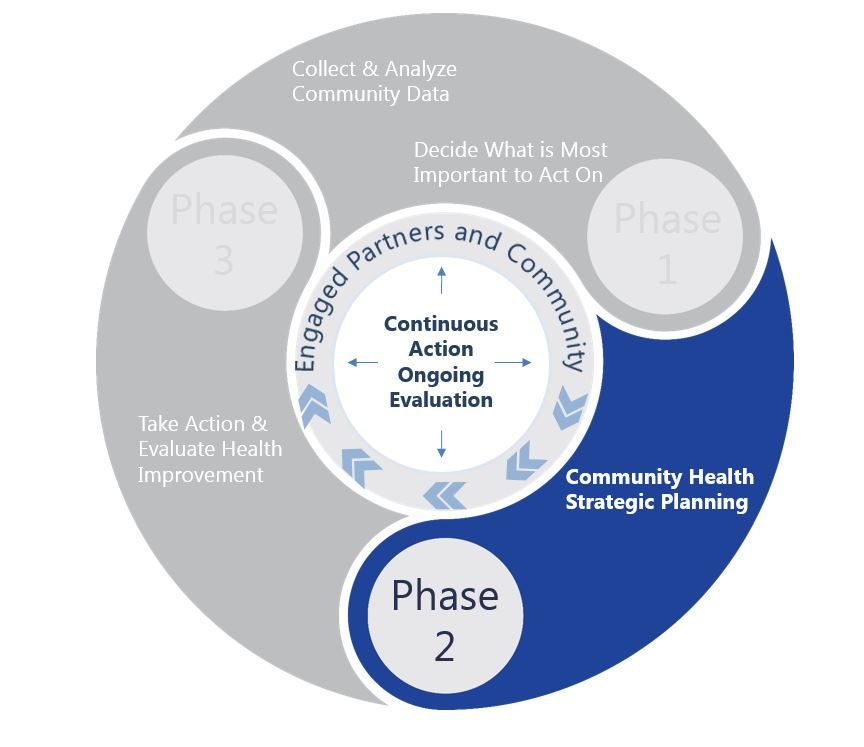
The second phase of the cycle is community health strategic planning. In this phase, leads make a plan with partners about what works to do better, form workgroups around each strategic area, clarify customers, and determine customer results and measures. The second phase results in a Community Health Improvement Plan (CHIP) and Action Plan forms from public health, and in a Hospital Implementation Strategy from hospitals.
- Guidance and Tools – To Come January 2019
TAKE ACTION & EVALUATE HEALTH PERFORMANCE (PHASE 3)
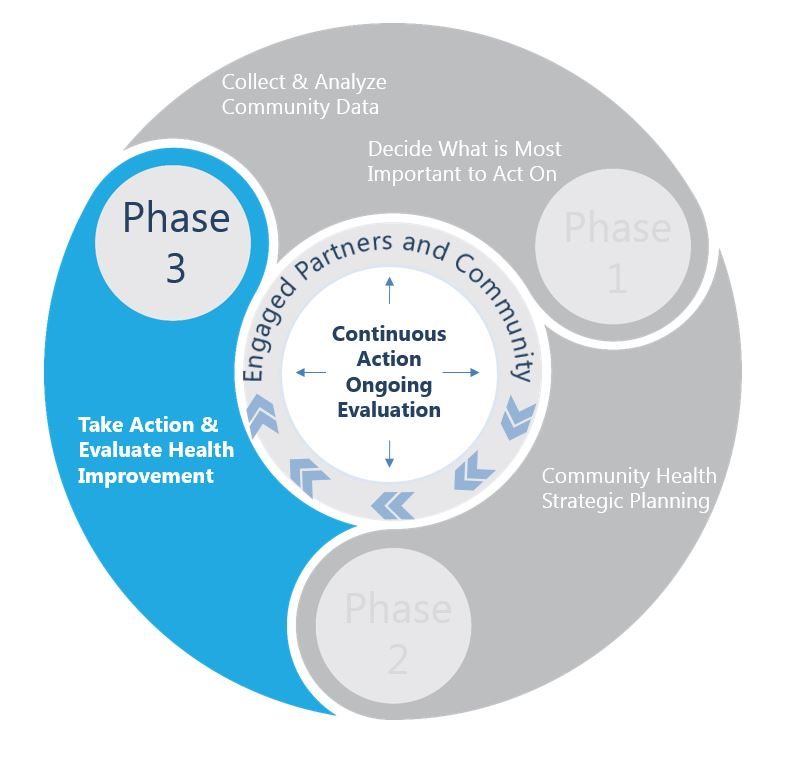
In the third phase of the cycle, CH(N)A leads take action and evaluate health improvement. They do this by planning how to achieve customer results and putting the plan into action. Workgroups continue to meet, and monitor customer results and make changes to the plan as needed. The third phase results in a State of the County Health (SOTCH) Report from public health, and in an IRS Form 990 – Schedule H from hospitals.
ACTION TOOLS
-
2016-2019 Regional Health Priority Scorecards and Tool Kits
One-pager describing how Scorecards can be used in regards to local and regional data, as well as links to three regional health priority Scorecards (Chronic disease, substance use, social determinants of health) -
Chronic Disease Scorecard & Toolkit
Direct link to Chronic Disease scorecard and toolkit -
Substance Use Scorecard & Toolkit
Direct link to Substance Use scorecard and toolkit -
Social Determinants of Health Scorecard & Toolkit
Direct link to Social Determinants of Health scorecard and toolkit -
Work Plan Template
Table template to help in the organization and implementation for a specific program/intervention/strategy -
Action Mapping Tool
Example of what action mapping looks like -
Action Mapping Tool – Instructions
One-pager with instructions for guidance through the action mapping activity -
Worksheet/Guidance—Identifying Performance Measures and Using Performance Measures for Performance Improvement
Worksheet designed to help guide performance monitoring and improvement efforts within the RBA framework -
Worksheet—Performance Measure Grid
Blank template designed in RBA format that helps to develop performance measures for a certain program/intervention/strategy -
Performance Turn the Curve Report Template
Blank template designed in RBA format to help develop a Performance Turn the Curve Report -
Population Turn the Curve Report Template
Blank template designed in RBA format to help develop a Population Turn the Curve Report -
Worksheet—My RBA Elevator Speech
Blank template designed in RBA format to help develop an “elevator speech;” a simple, clear, concise way to describe a program/intervention/strategy
REQUIREMENTS
HOSPITAL REQUIREMENTS
- Summary of New Requirements & Recommendations (Jan 2015, Catholic Health Association)
Document outlining requirements and recommended practices for non-profit health care providers. Catholic Health Association, January 2015 -
IRS- Form 990- Schedule H
Direct link to webpage with information regarding Schedule H (Form 990) for hospitals (IRS) -
Hospital CHNA Requirements
Webpage with additional requirements regarding Community Health Needs Assessments for Charitable Hospitals -
NC Health Department/Hospital Requirement Crosswalk Document (New 2015)
Document comparing ACA Hospital requirements, Accreditation and NC Community Health Assessment Process
- Community Health Assessment Accreditation Checklist 2015
Table listing accreditation activities and requirements for CHA
PUBLIC HEALTH REQUIREMENTS
- At risk and vulnerable population guidance 8.27.15
Document outlining CHNA requirements, the WNC Healthy Impact core dataset, and opportunities to consider for local data and community engagement related to at-risk populations - Community Health Assessment Accreditation Checklist 2015
Table listing accreditation activities and requirements for CHA